
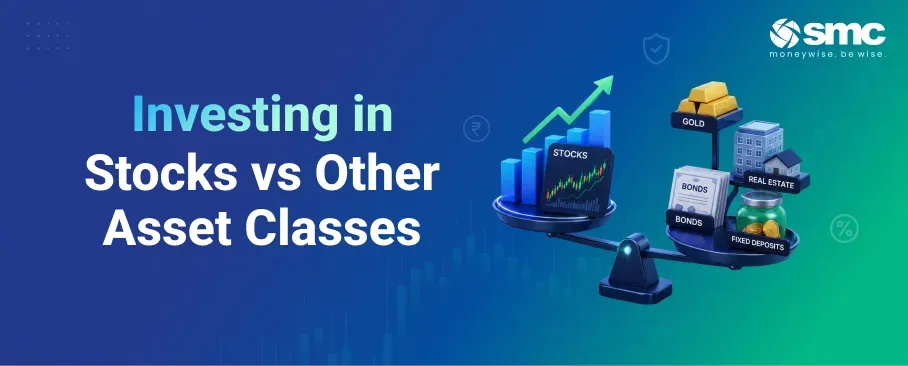


No single asset class wins every year. Stocks, bonds, real estate, gold, and alternatives each behave differently, and the one that leads in one year often lags in the next. That is why the smarter question is not "which is best" but which mix fits your goals, time horizon, and comfort with risk.
In this blog, we'll explore how the major asset classes work, how they compare in 2026, and how to choose the right mix for your goals.
#Understanding Asset Classes and Their Role in Investing
An asset class is a broad category of investments that share similar characteristics, risks, and return patterns. Different asset classes respond differently to economic conditions, which is why combining them can help balance growth, income, and stability within a portfolio.
The major asset classes include:
- #Equities (stocks): Stocks represent ownership in companies. Returns come from share price appreciation and dividends, but equity markets can experience significant short-term volatility and are generally more suitable for longer investment horizons.
- #Fixed income (bonds and deposits): Government bonds, corporate bonds, and bank deposits provide regular income and typically experience lower volatility than equities. Interest rates, inflation, and credit conditions influence their performance.
- #Real estate: Property investments can generate returns through rental income and capital appreciation. They may offer diversification benefits, although direct property investments are relatively illiquid and usually require larger amounts of capital.
- #Commodities (including gold): Prices are driven by supply and demand. Gold is often viewed as a store of value and has historically attracted investors during periods of inflation, currency weakness, or geopolitical uncertainty.
- #Mutual funds and ETFs: These pooled investment vehicles provide diversified exposure to a range of assets and investment strategies, making it easier for investors to access professional management or low-cost index investing.
- #Alternative investments: This category includes REITs, InvITs, private equity, infrastructure assets, and cryptocurrencies. These investments can provide additional sources of return and diversification but often involve higher complexity and liquidity constraints.
#Investing in Stocks
#How equity investing works
When you buy a stock, you own a small part of a company. Your returns come from two sources: the share price rising over time, and dividends. You can invest directly, or through mutual funds and ETFs that track indices such as the Nifty 50, S&P 500, or MSCI World.
In India, domestic investors now hold a larger share of equities than foreign investors, helped by steady SIP inflows. This shift reduces the market's dependence on foreign money and tends to soften the falls during global risk-off phases.
#Return potential and volatility.
Indian large-cap indices have delivered relatively steady returns, while mid- and small-caps have swung more widely. Globally, developed-market equities posted strong double-digit gains in 2025, and emerging markets did even better.
Major institutional outlooks for 2026 remain moderately positive on equities, with mid-single-digit to low-double-digit returns expected, supported by earnings growth, easing rates, and AI-driven spending. Volatility is likely to remain high given sticky inflation, geopolitical tensions, and trade policy uncertainty.
#Investing in Fixed Income Assets
#Bonds, fixed deposits, and debt instruments
Fixed income covers government bonds, corporate bonds, bank fixed deposits, and money-market instruments. In India, after a series of rate cuts through 2025, the policy repo rate has moved down to around 5.25%.
#Stability, income, and interest rate sensitivity
High-quality bonds and FDs move far less than stocks and pay a fixed income, which makes them core holdings for cautious investors. Bond prices do react to interest rates, though. When yields rise, bond prices fall, and longer-term bonds feel it most.
Most of the return from bonds now comes from interest rather than price gains, especially as the rate-cut cycle settles down.
#Investing in Mutual Funds
#Equity, debt, and hybrid fund categories
Mutual funds pool money from many investors into portfolios run by professional managers. The main types are equity funds (large, mid, and small-cap), debt funds, hybrid funds that mix equity and debt, and low-cost passive funds and ETFs that track an index.
Indian mutual funds saw strong inflows throughout 2025, and hybrid funds grew quickly as investors sought rule-based ways to manage volatility.
#Professional management and access
Mutual funds let small investors access professionally managed portfolios without researching individual stocks themselves. Monthly SIP inflows in India reached record highs in 2025, underscoring how widely systematic investing has been adopted. Many investors use low-cost passive funds for their core holdings and add selective active funds where a manager has more room to add value.
#Cost considerations and expense ratios
Every mutual fund charges a Total Expense Ratio (TER), which comes straight out of your returns. Passive funds usually cost less than actively managed ones, and even a small difference in fees can add up to a large gap in wealth over many years.
#Investing in Real Estate
#Investing in Gold and Commodities
- #Access options: You can hold gold as physical metal, digital gold, gold ETFs, gold mutual funds, or Sovereign Gold Bonds (SGBs). SGBs also pay periodic interest and can be tax-efficient if held to maturity.
- #Role and demand: Gold ETFs have delivered strong returns in certain periods, at times beating stocks and real estate, while demand for physical gold stays steady because it is so widely accepted.
- #Behaviour in different conditions: Gold often rises during geopolitical stress, currency weakness, or strong institutional buying. It has low correlation with other assets and tends to hold up better when equities fall.
- #Return characteristics: Prices can flatten out after a strong run, with returns driven more by interest rates and the broader economy than by steady compounding.
- #Commodities as an asset class: Beyond gold, commodities are cyclical and driven by supply and demand, so they work better as tactical positions than as core holdings.
#Investing in Alternative Assets
#REITs, InvITs, and private equity
In India, listed REITs and InvITs outperformed the Nifty 50 and government bonds in 2025, helped by lower rates and strong leasing activity. SEBI's move to classify REITs as equity-related instruments for mutual funds, effective January 2026, is opening up wider access.
Private equity and venture capital aim for high returns through unlisted investments, but they come with long lock-in periods and low liquidity.
#Cryptocurrencies and digital assets
The total crypto market swung widely through 2025. Bitcoin ended 2025 down about 6% and Ether about 11%. Behind the price moves, the ecosystem kept maturing through spot bitcoin ETFs, growth in stablecoins, and early real-world asset tokenisation.
Most investors keep crypto to a small share of their portfolio because of its sharp swings and the risk of large losses. It suits those with a higher tolerance for risk.
#Risk profile and regulatory uncertainty
Alternative assets add extra layers of risk: they can be hard to sell, their valuations often rely on models rather than live prices, and the rules around them can change. They are usually best used as small satellite holdings alongside your core investments.
#Comparing Asset Classes in 2026
#Expected returns and risk outlook
#Liquidity and ease of access
- Listed stocks, ETFs, and open-ended mutual funds are highly liquid.
- Bank FDs and listed REITs or InvITs are moderately liquid.
- Direct real estate and private equity are illiquid, with multi-year lock-ins.
#Tax efficiency and cost impact
India has overhauled how capital gains are taxed. The key points:
- #Listed stocks and equity mutual funds: Short-term gains (under 12 months) at 20%; long-term gains at 12.5% without indexation, above the exemption limit.
- #Debt mutual funds: Many bought after April 2023 are taxed at your slab rate regardless of how long you hold them.
- #Gold: Short-term gains at slab rate (under 24 months); long-term at 12.5% without indexation; SGBs are exempt at maturity.
- #Real estate: Long-term gains (over 24 months) at 12.5% without indexation, with reinvestment exemptions.
- #Crypto: A flat 30% on gains plus surcharge, with limited ability to set off losses.
Low-cost index funds create far less drag on returns than active funds charging 1-2.5% a year.
#Choosing the Best Asset Class Based on Your Goals
#Short-term vs long-term goals
- #Short-term (up to 3 years): Protecting your capital comes first. Liquid funds, short-duration bonds, and FDs are safer, since stocks and gold can fall sharply over short periods.
- #Medium-term (3-7 years): A mix of equity and fixed income, often through balanced or dynamic-allocation funds. A little gold can help hedge against shocks.
- #Long-term (7+ years): Equities are the main engine for building real wealth, having beaten bonds and cash over multi-decade periods despite the ups and downs along the way.
#Risk appetite and time horizon
- Cautious investors may lean on bonds, FDs, and a modest allocation to gold.
- Moderate investors often hold 40-60% in equities, usually through hybrid or multi-asset funds.
- Aggressive investors with long horizons may put more into equities and growth alternatives, holding small crypto positions only if they can afford the risk.
#Active vs passive investing
A core-satellite approach works well: use low-cost passive funds for broad market exposure, and add selective active funds in the less efficient corners of the market.
#Building a Balanced Portfolio for 2026
How you split your money across asset classes often has a greater impact on your long-term results than any single investment you choose. Adding a mix of asset types can also help create a more balanced portfolio.
For 2026, leading multi-asset outlooks suggest:
- Keeping equity exposure tilted toward quality and reasonably valued markets
- Holding high-quality bonds across durations for their yields and downside cushion
- Including gold and real assets for inflation protection and crisis hedging
- Considering select alternatives such as REITs and InvITs for extra income
For Indian investors, hybrid and multi-asset funds handle rebalancing and equity-debt allocation automatically.
After strong gains in gold and equities in 2025, many portfolios may now carry more risk than intended. Rebalancing on a schedule lets you lock in gains and move money into cheaper or steadier assets. Common methods are calendar-based (once or twice a year) and threshold-based (when an allocation drifts more than five percentage points from your target).
#Conclusion
No single asset class is the answer for everyone or for every year. Stocks drive long-term growth; bonds and FDs add stability; gold hedges against stress; and alternatives can boost income. The right approach is to match your mix to your goals, time horizon, and risk appetite, then review and rebalance it regularly.
Build a portfolio that balances growth, stability, and your long-term goals with the right mix of investments. Explore stocks, mutual funds, ETFs, and more through SMC Trade Online's smart investing platform. Open a Free Demat Account and start investing with confidence in 2026.


 1800 11 0909
 smc.care@smctradeonline.com